Building or renovating your home is a big commitment, and it is stressful when the work runs late, has defects or starts costing more than you agreed. Our building dispute lawyers in Melbourne help home owners across Victoria work out where they stand with their builder and what to do next.
Hendersons Legal is a Melbourne law firm established in 2001. Our building and construction lawyers act for home owners and investors in disputes about new homes, extensions and renovations, from the first letter to the builder through to the Building and Plumbing Commission (BPC) and VCAT. If you are looking for building dispute lawyers in Melbourne who will tell you plainly what your options are, this page explains how these disputes usually unfold.
We also act for builders and contractors (see our builders and contractors page), so we check for conflicts before we discuss the details of your matter. That side of our work also means we know how builders and their lawyers tend to respond to an owner’s claim. Our principal, David Henderson, has more than 30 years’ experience, and Melissa Henderson ran a home extension building company, Supa Group Constructions, until March 2015.
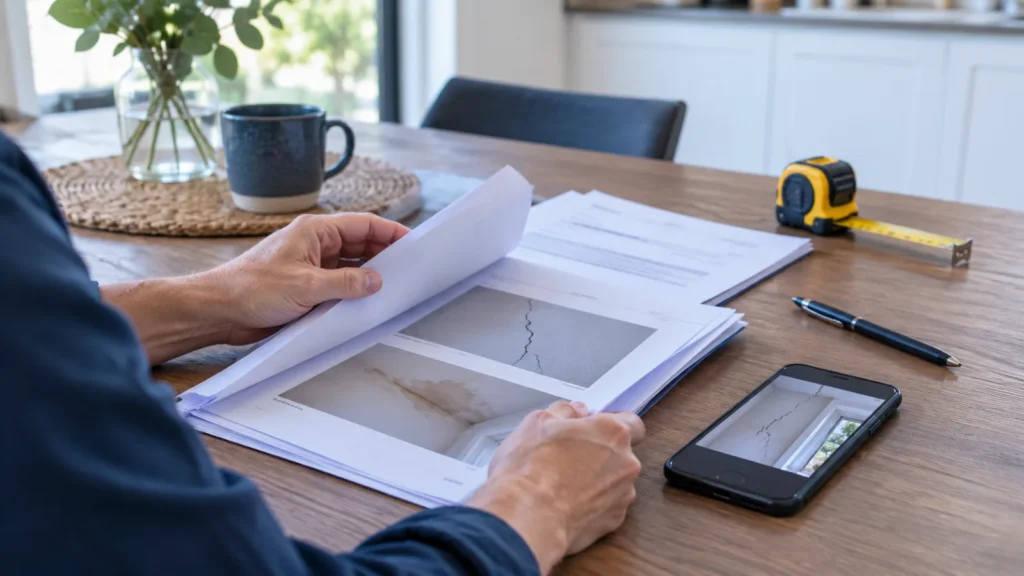
Common disputes between home owners and builders
Most of the disputes we see involve a domestic building contract for a new home, an extension or a renovation. They usually fall into one or more of the groups below.
Defective or incomplete work
Every domestic building contract in Victoria includes warranties set by the Domestic Building Contracts Act 1995 (Vic). Among other things, the builder warrants that the work will be carried out in a proper and workmanlike manner and in line with the plans and specifications, that the materials will be good and suitable for their purpose, that the work will comply with the law, including the Building Act 1993 (Vic), and that it will be done with reasonable care and skill (s 8).
These warranties form part of the contract even if the contract says nothing about them. A clause that tries to take away your right to sue for a breach is generally void, unless the breach was known, or ought reasonably to have been known, when the document was signed (s 10). If you bought the home from someone else, you can usually rely on the warranties as the current owner (s 9).
Delays and missed completion dates
The builder also warrants that the work will be finished by the date, or within the period, the contract sets (s 8(d)). Many contracts set an amount of liquidated damages for each day or week of delay. The builder may be entitled to extensions of time for events the contract recognises, such as bad weather or variations. Both sides have to follow the contract’s notice rules, so the paperwork matters.
Under a major domestic building contract, the Act also lets an owner end the contract if the price has risen by 15% or more, or the work has not been finished within one and a half times the agreed period, and the reason could not reasonably have been foreseen by the builder when the contract was made (s 41). Increases caused by prime cost items, provisional sums or variations you asked for are left out of that calculation, and you must give the builder a signed notice.
Variations and extra charges
A variation changes the plans or specifications after the contract is signed, and usually the price as well. For a major domestic building contract, the Act sets out how variations must be asked for and recorded (ss 37 and 38). If the builder has not followed that process, it is generally not entitled to recover money for the variation. The exception is where VCAT is satisfied there are exceptional circumstances, or the builder would suffer significant or exceptional hardship, and it would not be unfair to you for the builder to be paid.
For a variation the builder wants to make, the builder generally also has to show it was needed because of circumstances it could not reasonably have foreseen when the contract was signed (s 37).
Progress claims and final payment
The Act limits how much a builder can demand, recover or keep at each stage of a major domestic building contract (s 40). The builder must not demand final payment until the work has been completed in line with the plans and specifications and you have been given a copy of the occupancy permit or, where no occupancy permit is needed, the certificate of final inspection (s 42).
Before you hold back a payment, get advice. Refusing to pay an amount that is properly due can put you in breach of the contract and give the builder grounds to suspend work or end the contract.
When the relationship breaks down
Sometimes a builder stops coming to site, will not fix defects or keeps asking for payments the owner does not think are due. Ending the contract can be the right step, but it has to be done strictly in line with the contract and the Act. An owner who terminates without proper grounds, or without following the notice steps, can end up liable to the builder for wrongful termination. Talk to us before you send a notice or bring in another builder.
Victoria has also passed changes to domestic building contracts, including a new process for variations and new rules on payments. They are due to start by early 2027 and are expected to apply only to contracts signed after they start (Victorian Government). This page describes the rules that apply to existing contracts. For the full timeline, see our overview of Victoria’s 2026 building law and home warranty changes.
What to do first when something goes wrong with your build
- Keep a record. Take dated photos, keep every email and text message, and note what was said on site and when.
- Read your contract, including the special conditions, the plans and specifications, and any variation documents.
- Raise the problem with your builder in writing and give them a reasonable chance to respond. The BPC expects you to have tried to resolve the dispute before it will accept an application.
- Check that your builder is registered, using the BPC’s practitioner search, and find your insurance paperwork: a domestic building insurance certificate for older contracts, or a Home Warranty Notice of Cover for newer ones.
- Think about getting an independent building inspection. A written report gives you something concrete to put to the builder.
- Get advice before you withhold money, end the contract or have someone else fix the work.
How domestic building disputes are resolved in Victoria
Building and Plumbing Commission dispute resolution
The BPC was established on 1 July 2025. It brought together the Victorian Building Authority, Domestic Building Dispute Resolution Victoria (DBDRV) and the domestic building insurance arm of the Victorian Managed Insurance Authority. Its free dispute resolution service, which used to be run by DBDRV, deals with disputes about domestic building work, including defective or incomplete work, delays, payment and contract issues.
For a dispute to be eligible, it must involve the building owner, you must have taken reasonable steps to resolve it directly with the other party within the last three months, and the work must not be more than 10 years old. Commercial building work is not covered, and a dispute that is or has been before VCAT or a court is generally not eligible.
A dispute resolution officer first assesses whether the dispute is suitable for conciliation. If it is, the parties take part in conciliation to try to reach an agreement, and an assessor may inspect the work to decide whether it is defective or incomplete. If the dispute is not resolved, the BPC may issue a binding dispute resolution order, or a certificate of conciliation that allows a party to apply to VCAT. Requests for a legal representative to attend conciliation are considered case by case.
Plenty of owners go through this process on their own. We can help you prepare the application and supporting documents, get ready for conciliation and, where the BPC allows it, act for you at conciliation.
VCAT
Domestic building disputes that do not settle are usually heard in VCAT’s Building and Property List. In general, a party cannot apply to VCAT about a domestic building work dispute without a certificate of conciliation from the BPC. An application for an injunction is an exception (Domestic Building Contracts Act 1995 (Vic) s 56).
At VCAT each party generally pays its own costs. VCAT can order one party to pay some or all of another party’s costs where it is satisfied that is fair, for example because of the way a party has conducted the case (Victorian Civil and Administrative Tribunal Act 1998 (Vic) s 109). We talk you through the likely costs and risks before you commit to a hearing. Our litigation page explains how we run tribunal and court matters.
Rectification orders
Since 1 July 2026 the BPC can issue rectification orders requiring a builder, or another person who carried out the work, to fix or complete defective, non-compliant or incomplete building work. Orders can be issued during construction and for up to 10 years after practical completion or the issue of an occupancy permit, including after you have moved in. You can ask the BPC to consider an order, but it decides case by case whether one is appropriate. Our guide to rectification orders in Victoria explains how the process works for owners and builders.
Home warranty insurance when your builder can’t or won’t fix the work
Which insurance scheme applies depends on when you signed your contract.
Contracts signed on or after 1 July 2026 fall under the BPC’s Home Warranty scheme, which applies to eligible domestic building work valued at more than $20,000. If your builder is unable or unwilling to complete or fix eligible work that is incomplete, defective or non-compliant, you may be able to make a claim. Cover for major defects can last up to six years after the work is completed, and up to two years for other defects. As at November 2026, assistance is capped at $400,000 in total per home, and other limits and exclusions apply.
Contracts signed before 1 July 2026 stay under the earlier domestic building insurance (DBI) policies. Those policies generally respond only in narrower situations, such as where the builder has died, disappeared or become insolvent.
Claims have time limits. For a Home Warranty claim about defective or non-compliant work, the BPC says the claim must be made within 12 months after you first become aware, or should reasonably have become aware, of the problem. Home Warranty also does not protect owners who used an unregistered builder for work that needed a registered builder. If an insurer’s decision goes against you, VCAT can review it. We can help you prepare a claim, respond to a decision and think through any offer before you accept it. Our article on the 2026 changes covers Home Warranty time limits in more detail.
Time limits for building claims
In Victoria, a building action generally cannot be brought more than 10 years after the occupancy permit was issued, or after the certificate of final inspection if no occupancy permit was issued (Building Act 1993 (Vic) s 134). Other time limits can apply, the starting date is not always obvious, and the BPC and insurance deadlines above can be much shorter. If something is wrong with your build, get advice early.
How our building dispute lawyers in Melbourne help home owners
- Reviewing your contract, plans, variations and correspondence, and explaining where you stand.
- Writing to your builder to set out your position and ask for the work to be fixed or finished.
- Preparing BPC dispute applications and helping you through conciliation.
- Running VCAT proceedings for home owners, and appeals where needed.
- Home warranty claims, and reviews of insurer decisions at VCAT.
- Advising before you end a contract or hold back a payment.
- Negotiating a settlement with your builder and putting it in writing.
We have acted for applicants and respondents at DBDRV and VCAT, and in appeals to the Supreme Court. We see a hearing as a last resort, so where we can, we look for a practical way to resolve the dispute early.
Still choosing a builder, or about to sign? A building contract review before you sign can head off many of the problems on this page.
This is general information, not legal advice. Every building project is different, so get in touch about yours.
How it works
- Call (03) 9629 2211 or send us the details through our online enquiry form. Tell us what has gone wrong and upload what you have, such as your contract, photos, inspection reports and emails with your builder.
- We clarify your instructions and take a first look at the documents.
- We send you a costs agreement and disclosure statement setting out the scope of the work and our fees.
- Once you accept, we start work and keep you posted.
Send us the details
Use our online enquiry form to tell us about your dispute and upload your contract and any photos or reports. Our building dispute lawyers in Melbourne will come back to you about next steps. If a deadline is close, call (03) 9629 2211 as well, because an enquiry does not stop time running.
Questions home owners ask about building disputes
Do I have to go to the BPC before VCAT?
In most cases, yes. A party to a domestic building work dispute generally needs a certificate of conciliation from the Building and Plumbing Commission before applying to VCAT. Applications for an injunction are an exception, and some disputes that are not eligible for the BPC’s service can go straight to VCAT.
Can I stop paying my builder if the work is defective?
Be careful. Refusing to pay an amount that is properly due under the contract can put you in breach and give the builder grounds to suspend work or end the contract. For a major domestic building contract, the Domestic Building Contracts Act 1995 (Vic) does limit what a builder can demand at each stage, and final payment cannot be demanded until the work is complete and you have the occupancy permit or certificate of final inspection. Get advice before you hold back any money.
How long do I have to make a claim for defective building work?
In Victoria, a building action generally cannot be brought more than 10 years after the occupancy permit was issued, or after the certificate of final inspection if there was no occupancy permit (Building Act 1993 (Vic) s 134). Shorter limits can apply to insurance claims. For example, a Home Warranty claim about defective work must be made within 12 months after you first become aware, or should reasonably have become aware, of the problem. Get advice early.
Does my builder have to fix defects after I have moved in?
The builder’s warranties under the Domestic Building Contracts Act 1995 (Vic) do not end when you move in. Since 1 July 2026, the Building and Plumbing Commission can also issue rectification orders for defective, non-compliant or incomplete work for up to 10 years after practical completion or the occupancy permit. The BPC decides case by case whether to issue an order.
Can my builder charge for a variation I did not agree to in writing?
Under a major domestic building contract, a builder is generally not entitled to recover money for a variation unless it followed the process in the Domestic Building Contracts Act 1995 (Vic). VCAT can allow the builder to be paid in limited cases, such as exceptional circumstances or significant hardship to the builder, where that would not be unfair to the owner.
I bought my home from the previous owner. Can I still claim against the builder?
Often, yes. The current owner of the home can take proceedings for a breach of the builder’s statutory warranties as if they were a party to the original building contract (Domestic Building Contracts Act 1995 (Vic) s 9). Time limits still run from the occupancy permit or certificate of final inspection, not from when you bought, so check them early.
Who pays the legal costs in a VCAT building dispute?
Each party generally pays its own costs at VCAT. VCAT can order one party to pay some or all of another party’s costs if it is satisfied that is fair, for example because of the way a party has conducted the proceeding (Victorian Civil and Administrative Tribunal Act 1998 (Vic) s 109). We explain the likely costs and risks before you decide to go ahead.
Having problems with your builder?
Call (03) 9629 2211 or send us the details. We confirm the scope and our fees in writing before we start.